
Last updated: May 2026
The Herbst appliance was developed in 1904 by Dr. Emil Herbst, a German orthodontist. It sat dormant in the literature for roughly 75 years before Hans Pancherz reintroduced it through his work at Malmö University in Sweden in 1979. It is now one of the most prescribed Class II functional appliances worldwide, and most of what we know about its clinical effects traces back to Pancherz’s published work between 1980 and his death in March 2023.
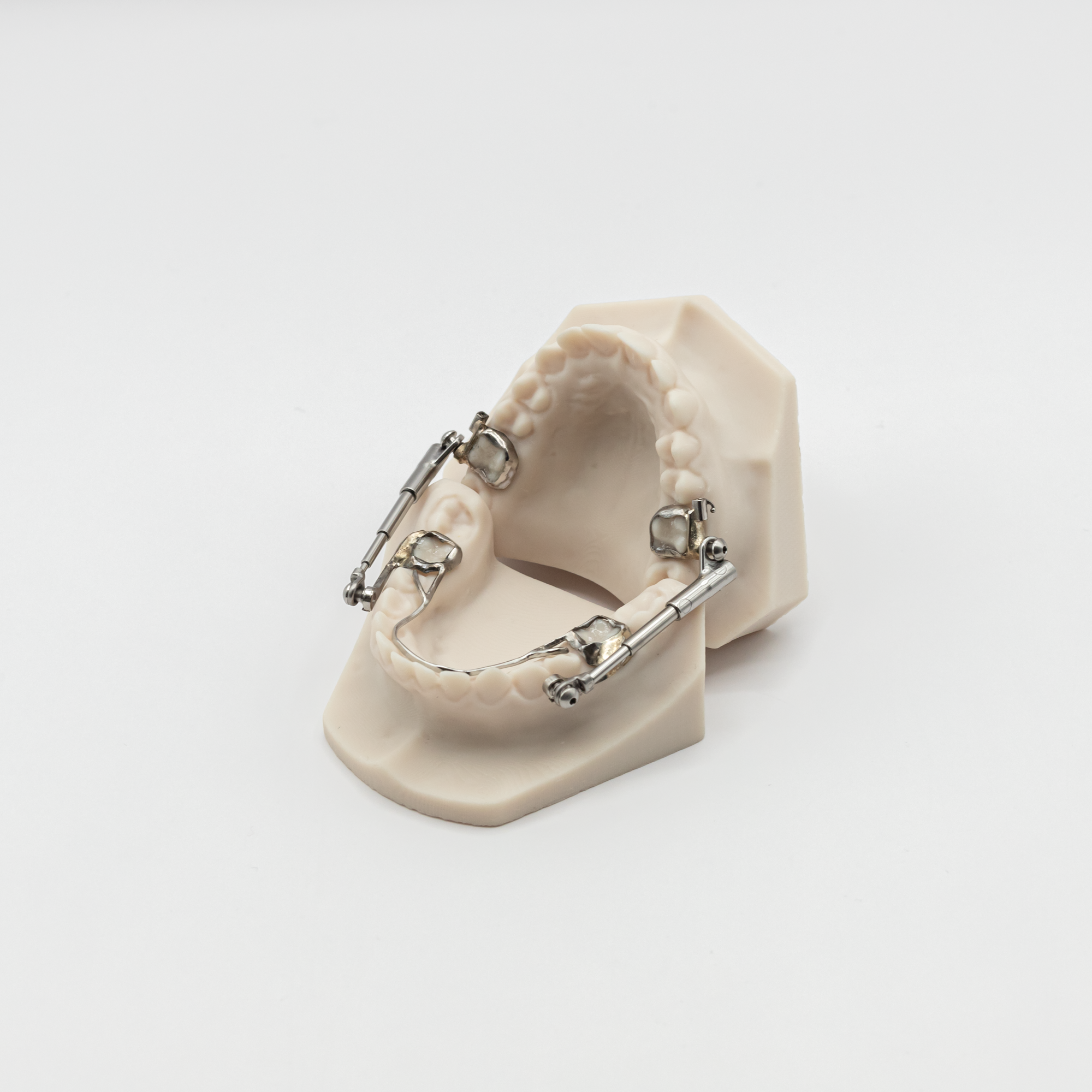
We have a stake in this history. Specialty fabricates the MiniScope® Herbst, an in-house design we developed to give clinicians a Class II correction appliance their patients would actually tolerate, with smaller telescoping arms and improved hygiene. This article covers what the Herbst is, how its variants differ, and when to choose it.
What Is a Herbst Appliance Used For?
A Herbst appliance is a fixed Class II functional appliance that uses bilateral telescoping mechanisms attached between the maxillary and mandibular dentition to hold the mandible in a forward position continuously. The continuous mandibular advancement produces Class II correction primarily through a combination of skeletal change (mandibular growth response in growing patients) and dental change (distal movement of maxillary molars, mesial movement of mandibular dentition). It is most effective in growing patients near or just after the pubertal growth spurt.
A Short History: From Emil Herbst to Hans Pancherz
Dr. Emil Herbst presented the appliance to the dental community in 1909, after developing it around 1904. It was used in Europe for the first half of the 20th century but remained relatively obscure in the United States and largely unmentioned in orthodontic literature for decades.
Hans Pancherz, working at Malmö University in Sweden, reintroduced the appliance to the orthodontic profession in 1979. Through prospective clinical research and long-term follow-up of treated cases (some followed for more than 30 years post-treatment), Pancherz established the clinical effects of the appliance: mandibular growth stimulation, maxillary growth inhibition (the “headgear effect”), and the dentitional changes that contribute to Class II correction. He published continuously on the appliance until his death in March 2023, and his cumulative work remains the primary clinical reference for Herbst treatment.
The rod-and-tube telescoping mechanism that defines the contemporary appliance is essentially unchanged from the original 1904 design. What has changed is how the appliance is anchored, miniaturized, and integrated into modern orthodontic workflows. Specialty’s pillar reference on the Herbst appliance covers the Pancherz body of work in more detail.
How the Herbst Produces Class II Correction
The Herbst appliance produces Class II correction through what Pancherz called “bite jumping”: holding the mandible in a forward position continuously, 24 hours a day, throughout active treatment.
The clinical effect, documented by Pancherz in the 1982 AJODO paper that established the mechanism in the modern literature, breaks down to roughly equal skeletal and dental contribution. In his 42-case study, Pancherz reported that Class II molar correction averaging 6.7 mm came from a combination of approximately 2.2 mm of mandibular length increase, 2.8 mm of distal maxillary molar movement, and 1.0 mm of mesial mandibular dentition shift. The proportion of skeletal to dental change varies by patient age, growth status, and appliance design.
The mechanism has implications for case selection:
- In growing patients with active mandibular growth, the Herbst can produce significant skeletal change.
- In patients past the pubertal growth spurt, the same appliance produces primarily dental change (distal molar movement, mesial mandibular movement). The Class II correction still occurs; it just shifts from skeletal to dental.
- In all patients, the appliance produces a “headgear effect” on the maxilla: distalizing the maxillary dentition reciprocally with the mandibular forward holding.
Patient compliance is built into the appliance design. Unlike removable functional appliances (twin-block, bionator), the Herbst is fixed and active 24/7 once placed. The clinician does not need to enforce wear time.
Herbst Design Variations
Not all Herbst appliances are the same. The major design variations affect patient tolerance, hygiene, and clinical performance:
Anchorage type.
- Banded Herbst: attached to molar bands. Easier to deliver chairside, harder to maintain hygiene around the bands during treatment.
- Crown-mounted Herbst: attached to full-coverage crowns on the anchor teeth. More durable, better cement retention, slightly more complex to deliver.
Telescoping mechanism size.
- Traditional Herbst: larger telescoping arms; more bulk in the buccal corridor; harder for patients to clean and adapt to.
- MiniScope®: miniaturized telescoping arms; smaller buccal-corridor footprint; better hygiene; better patient tolerance.
Activation method.
- Fixed-position Herbst: mandible held in a single advanced position throughout treatment.
- Stepwise-advanceable Herbst: mandible advanced in stages over treatment; theoretical advantage for severe Class II cases requiring large advancement.
Mechanism type.
- Rod-and-tube (telescoping piston): the classic Pancherz design.
- Cantilever / flip-lock variations: some modern designs offer flip-lock connections for easier troubleshooting when components break.
The design that fits the case best is rarely the default. For specific cases, the lab can advise on which variation to specify on the prescription.
The MiniScope® Herbst: A Specialty Origina
The MiniScope® Herbst is one of Specialty’s proprietary appliance designs. We developed it in-house to address a specific clinical observation: the bulk of the traditional Herbst telescoping arms was making the appliance harder to tolerate for adolescent patients, more difficult to clean, and more prone to soft-tissue irritation in the buccal corridor.
The MiniScope® design miniaturizes the rod-and-tube assembly without compromising the bite-jumping mechanics. Same Class II correction mechanics. Smaller arms. Better hygiene. The M4™ MiniScope® Herbst is the latest variant in this product line.
This is an example of what Specialty means by “built, not borrowed.” The MiniScope® was designed by our lab to solve a clinical problem we observed across thousands of Herbst fabrications. It has been in active production for over two decades and remains the design our long-tenured customers come back for.
When the Herbst Is the Right Class II Appliance
The Herbst is the right appliance when:
- The patient has Class II malocclusion suitable for functional correction.
- The patient is at or near the pubertal growth peak (for maximum skeletal contribution) or in a window where dentoalveolar correction is acceptable.
- 24/7 fixed-appliance compliance is preferable to removable-appliance wear-time enforcement.
- The case is not better served by alternative functional appliances (the MARA appliance, twin-block, or others).
The Herbst is not always the right choice for adult patients, but it is not categorically excluded either. Ruf and Pancherz published a 2006 study in the European Journal of Orthodontics on adult Class II Division 1 correction with the Herbst-plus-multibracket protocol, with patient ages ranging from 15.7 to 44.4 years. All 23 consecutive cases reached Class I occlusion. Adult Herbst is feasible; the skeletal contribution is reduced and the case relies more on dental and dentoalveolar effect.
For borderline cases, call our tech team for case-design questions before submitting the prescription.
Frequently Asked Questions
Is the Herbst appliance painful?
Patients typically report soreness during the first 24-72 hours after delivery, with discomfort decreasing as they adapt. The continuous mandibular advancement produces some pressure throughout the active treatment phase.
How long does Herbst treatment take?
Active Herbst treatment typically runs 6-12 months depending on the magnitude of Class II correction required, with the original Pancherz protocol described as 6 months of bite jumping followed by multibracket finishing.
Can adults wear a Herbst appliance?
Yes. While Pancherz emphasized that the Herbst’s full skeletal effect is best in growing patients near the pubertal peak, adult Herbst treatment is well-documented. Ruf and Pancherz (2006) reported successful Class I outcomes in 23 consecutive adult Class II Division 1 cases with pre-treatment ages from 15.7 to 44.4 years.
In adults, the appliance produces less mandibular growth response (because growth has slowed or ceased) and more dentoalveolar change. The Class II correction still occurs through molar distalization, incisor decompensation, and mandibular dentition mesial movement. Adult Herbst treatment is most successful when the clinician selects cases where the patient is willing to accept primarily dental correction or has a borderline skeletal pattern where dentoalveolar compensation produces acceptable facial outcomes.
The 2014 work by Hohoff and others examining Herbst combined with fully individualized lingual appliances or as an alternative to orthognathic surgery in adult Class II cases has expanded the appliance’s adult indication. The Herbst is not surgery, and it cannot reproduce surgical-level skeletal change in adults. It can produce Class II correction sufficient to avoid surgery in selected borderline cases.
Herbst vs MARA: which is better?
Neither is universally better. The Herbst uses bilateral telescoping mechanisms; the MARA uses fixed mandibular advancement through interlocking upper and lower components without telescoping arms. The MARA has a smaller buccal-corridor footprint and is sometimes preferred for hygiene; the Herbst has longer published outcome data and more design variation available. The choice depends on the case, the clinician’s experience, and patient-tolerance considerations.
Conclusion
The Herbst appliance has been the workhorse of fixed Class II correction for more than a century, with the modern clinical evidence base built largely by Hans Pancherz between 1979 and 2023. The variations matter. The MiniScope® Herbst is Specialty’s contribution to that lineage: smaller telescoping arms, the same bite-jumping mechanism, better patient tolerance.
If you’re prescribing a Herbst for a borderline case, submit the scan for case-design review before specifying.