
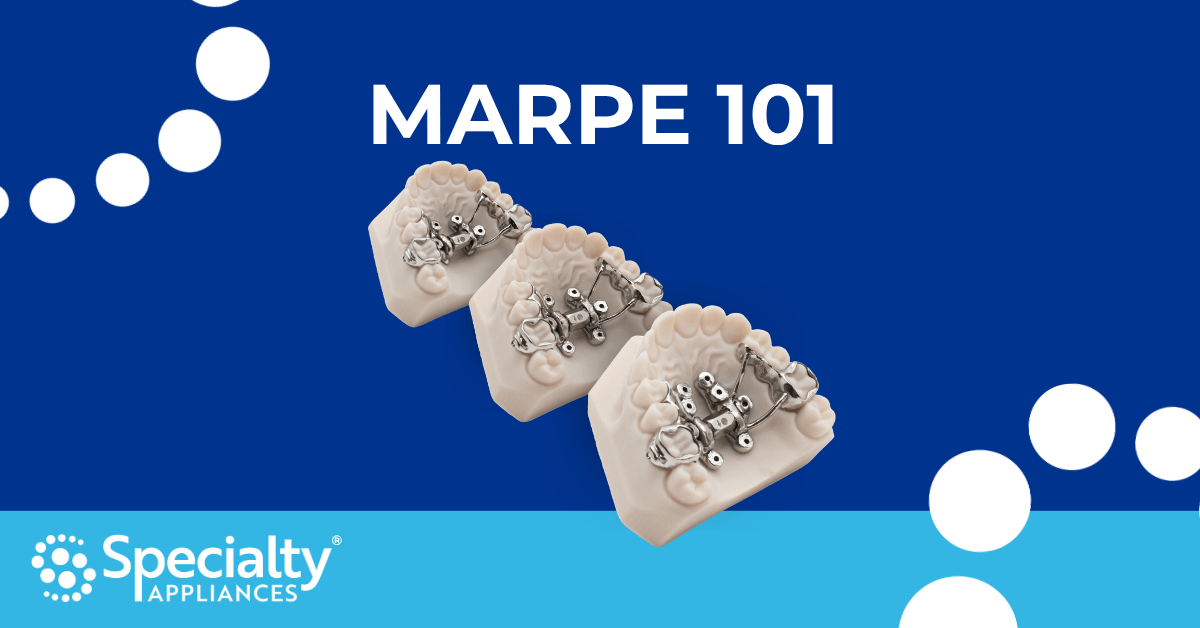
Last updated: May 2026
A patient sits in the chair. Twenty-eight years old, 8 mm bilateral crossbite, asking if you can expand the palate without surgery. The honest answer depends on a CBCT image you may not have ordered yet. MARPE and SARPE both work for adult transverse maxillary deficiency. The wrong choice for this patient, this palate, this maturation pattern wastes weeks of activation or sends them to an OMF surgeon they didn’t need.
At Specialty Appliances, we fabricate MARPE appliances for orthodontists across the country. We also see which cases come back for redesign and which get referred out to SARPE after MARPE activation stalls. The decision rule the textbook teaches (MARPE for younger adults, SARPE for older) is a useful starting point. It is not the rule the lab uses when reviewing a borderline scan.
What’s the Difference Between MARPE and SARPE?
MARPE (miniscrew-assisted rapid palatal expansion) opens the midpalatal suture using TAD-anchored force, with no surgery. SARPE (surgically-assisted rapid palatal expansion) opens the suture after an OMF surgeon performs a corticotomy to release the lateral resistance areas. MARPE is appropriate for adults whose midpalatal suture is not fully ossified. SARPE is required when the suture is fully ossified or when MARPE has failed.
Both produce transverse skeletal expansion. The choice between them is not about which works better in general. It is about which works for this patient’s palate.
Why Midpalatal Suture Maturation Matters More Than Age
The instinct to age-gate adult expansion is understandable. Below 18, the suture is almost always patent. Above 25, it usually isn’t. Somewhere in between, you guess. The guess is wrong often enough that the lab sees the consequences.
The better variable is the Angelieri CBCT staging system, published in 2013 and refined in 2017. It assigns one of five stages (A through E) to the midpalatal suture based on its appearance in a cross-sectional CBCT image. Stages A and B are open. Stage C is partially fused with bridging in the maxillary region. Stages D and E show progressive ossification, with stage E representing complete fusion and the radiographic disappearance of the suture itself.
Chronological age correlates with stage. It does not determine it.
A 35-year-old with a stage B-C suture can be a MARPE candidate. A 22-year-old with a stage D-E suture probably cannot. We have seen both. The 35-year-old expanded predictably with the MARPE appliance we fabricate. The 22-year-old activated for nine weeks and produced dental tipping without skeletal split. The CBCT had been read as “patent suture” at the consult. On second review, the bridging was clear in the axial slice.
The implication is practical. If you have not ordered a CBCT before recommending MARPE to a skeletally mature adult, you are guessing. The guess sometimes works. When it does not, the patient pays for it in chair time and the clinician pays for it in referral.
Order the scan. Stage the suture. Then decide.
Where MARPE Wins (and Where It Fails)
MARPE is indicated for adults with stage A through stage C midpalatal sutures who present with skeletal transverse deficiency. The appliance achieves skeletal split without surgical intervention, recovery, or OMF coordination. Active expansion typically runs 3 to 7 weeks (roughly 20-35 days) under a rapid protocol of one to two turns per day, followed by 3 to 6 months of retention to allow consolidation of the new bone. Patient compliance is comparable to conventional RPE.
MARPE fails in three predictable patterns:
- Suture maturation underestimated. Stage D-E sutures resist split regardless of activation rate. Tipping increases, skeletal split does not.
- Insufficient palatal cortical bone for TAD purchase. Thin or asymmetric cortical bone gives the miniscrews inadequate anchorage. The appliance activates, the TADs migrate, the force never transfers to the suture.
- Asymmetric expansion. When one side of the palate has more compliant bone than the other, force distribution becomes uneven. The clinician sees one quadrant opening and the other resisting.
The first failure is preventable with a staged CBCT. The second is preventable with attention to cortical bone thickness on the same scan. The third is harder to predict and is one of the case-design conversations we have most often with referring clinicians.
For patients where TAD-anchored expansion is preferred but palatal anatomy is borderline, the MSE expander is sometimes a better choice. The two appliances have different anchorage geometries and the lab can recommend based on the scan.
Where SARPE Wins (and What It Costs the Patient)
SARPE is indicated for adults whose midpalatal suture is fully ossified (stage E) or whose lateral resistance areas (the zygomaticomaxillary buttress and pterygomaxillary junction) are too dense for non-surgical separation. It is also indicated as a recovery option when MARPE has failed and surgical assist becomes necessary to complete expansion.
What SARPE wins: a predictable skeletal split for patients who cannot get one any other way. The surgical corticotomy releases the lateral resistance, and a conventional or bone-borne expander then opens the suture without the unpredictability of TAD-anchored adult expansion.
What it costs the patient: an OMF surgical referral, general or IV sedation, a recovery window typically running 1-2 weeks before activation, and the cost differential of a surgical procedure. Patients who would not consider surgery for orthodontic purposes are not SARPE candidates, regardless of what the staging says.
The lab does not fabricate SARPE-specific appliances differently from conventional expanders in most cases. The decision happens upstream of the lab, between the clinician and the OMF surgeon.
A Lab-Side Decision Framework
The decision tree we walk through with referring orthodontists when a borderline case comes in:
Step 1: Order a CBCT and stage the midpalatal suture. If the patient has not had a recent CBCT, the decision is premature. Staging is the first variable.
Step 2: Review the staging result against the patient’s surgical appetite.
- Stage A-B → MARPE is the default. Strong candidacy.
- Stage C → MARPE is feasible; cortical bone review and SME consultation recommended.
- Stage D → MARPE is high-risk; SARPE is the safer skeletal split. Discuss surgical appetite with the patient.
- Stage E → SARPE is required for skeletal expansion. MARPE will produce dental compensation, not skeletal correction.
Step 3: Check palatal cortical bone thickness on the same CBCT. For MARPE candidates, the lab needs to see at least 3 mm of cortical bone in the planned TAD placement region. Thinner bone or asymmetric anatomy means the miniscrews will not anchor reliably, regardless of suture stage.
Step 4: Submit the scan for case-design review. For any stage B-D case, we recommend the orthodontist review the appliance specs with our tech team before submitting. The lab can flag anatomy concerns the consultation might have missed. This is also where our digital lab workflow integrates with the clinician’s scan submission.
The framework does not eliminate every failed MARPE case. It eliminates the predictable ones.
What We See When MARPE Cases Come Back
The cases that come back to the lab for redesign or referral usually share one of two markers. Either the suture stage was underestimated at consultation and skeletal split never occurred, or the TAD anchorage failed because cortical bone was inadequate.
Most of these cases are recoverable. Some require referral to SARPE. None of them should have been surprises, in the sense that the scan that came with the case usually showed the problem before activation began. If a case feels borderline, call our tech team before submitting. A 10-minute scan review at the front end prevents a re-prescription at week 9.
Frequently Asked Questions
Is MARPE painful for adults?
Most patients report pressure rather than pain during the first 48 hours after activation begins, with discomfort decreasing through the first week.
What age is too old for MARPE?
There is no fixed age cutoff for MARPE. The relevant variable is midpalatal suture maturation, which is assessed on CBCT using the Angelieri staging system. Patients with stage A through C sutures are generally MARPE candidates regardless of chronological age. Patients with stage D-E sutures are not, even if they are in their early twenties.
In practical terms, MARPE candidacy declines through the third decade as suture ossification progresses, and most clinicians find the candidate pool thins significantly after age 30. But a 35-year-old with an unfused suture can still be expanded with MARPE, and a 22-year-old with a fused suture cannot. The scan determines candidacy. Age only correlates with the scan.
Can MARPE fail?
Yes. The most common MARPE failure modes are (1) underestimated suture maturation, where the suture is more ossified than the consultation assessment suggested and skeletal split does not occur; (2) inadequate palatal cortical bone for TAD anchorage; and (3) asymmetric expansion when one side of the palate is more compliant than the other.
How long does MARPE take vs SARPE?
MARPE active expansion typically runs 3-7 weeks (about 20-35 days) under a rapid protocol, with retention following for 3-6 months. SARPE adds an OMF surgical visit and a 1-2 week recovery before expansion begins; once expansion starts, the active and retention timelines are roughly comparable to MARPE.
Is MARPE FDA cleared?
The TAD components used in MARPE appliances are FDA-cleared as medical devices. The appliance itself is a custom orthodontic device fabricated per clinician prescription.
Conclusion
The MARPE vs SARPE question is not a preference question. It is a maturation-pattern, anchorage-quality, and risk-tolerance question that the CBCT answers first and the lab confirms second. The patient in the chair with the 8 mm crossbite needs a scan before they need a recommendation.
We fabricate the MARPE appliance and we see the cases that come back. Most failures are visible on the scan that arrived with the case. If the case feels borderline, send the scan for review before you commit the patient to weeks of activation that may not produce skeletal split.