
Last updated: May 2026
A 32-year-old presents with 7 mm bilateral crossbite, requests adult expansion, refuses surgery. The patient is well within the literature’s “MARPE-eligible” age range. The published success rate for patients in their early-to-mid thirties drops considerably from the late-twenties window. Both statements are true. The question isn’t whether MARPE is an option. The question is whether this patient should hear the actual odds before agreeing to the appliance.
We fabricate MARPE appliances for orthodontists across the country. We also see the cases that come back when adult MARPE doesn’t produce skeletal split. The published data and lab experience point to the same conclusion: adult MARPE works, but candidacy is a narrower window than the broader “adults” framing suggests, and the determining variable is sutural maturation, not the calendar.
Does MARPE Work in Adults?
Yes. MARPE produces skeletal expansion in adults when the midpalatal suture is not fully ossified and palatal cortical bone is adequate for TAD anchorage. Published success rates range from roughly 80 to 94 percent in patients aged 15 to 29 and decline significantly past age 30. Candidacy depends on CBCT-confirmed midpalatal suture stage, not chronological age in isolation.
The Age-Success Curve in Published Literature
Three data points are worth holding in mind when prescribing MARPE for adult patients.
First, the long-term efficacy meta-analysis of MARPE in late adolescents and adults (PMC10623697, 2023) reports a mean success rate of 93.87% across the combined cohort. This is the number most often cited for “MARPE works in adults.”
Second, the age stratification matters. A 2023 review published in the Journal of Esthetic and Restorative Dentistry (Akyalcin et al.) reports that the combined success rate of suture separation for patients aged 15-29 is slightly above 80 percent, with the rate declining to approximately 20 percent for patients aged 30-37. That is not a gentle decline. It is a cliff.
Third, individual prospective studies that include older adults show variable results. The Dutch Maxillary Expansion Device cohort (PMC9525423) reported a 94.1% success rate in 34 patients with mean age 27 years. Other studies focused on adults in their twenties and thirties report rates from 71% (Oliveira et al.) to 87% (Choi et al.) depending on appliance design, protocol, and inclusion criteria.
The pooled headline number (94%) and the age-stratified number (80% young adults, 20% mid-thirties) are not contradictory. They describe different cohorts. The clinician prescribing MARPE for an adult patient needs the age-stratified number, not the pooled one.
Why Chronological Age Is a Proxy, Not a Determinant
The cliff between the 20s and 30s success rates is not about birthdays. It is about the average rate of midpalatal suture ossification across the population. Most patients in their late twenties have a suture that is still patent or partially patent. Most patients in their late thirties have a fully ossified suture. The decade in between is the candidate-pool transition zone.
Individual patients vary. A patient in their mid-thirties with a stage B or C suture can be a MARPE candidate. A patient in their early twenties with a stage D or E suture is not. We see both. The CBCT stage carries more diagnostic weight than the age on the chart.
The implication for prescribing: do not screen out adult MARPE candidates by age alone, and do not assume a young adult is automatically a candidate. Stage the suture on CBCT, then decide.
A Lab-Side Adult MARPE Candidacy Framework
The candidacy assessment we walk through with referring orthodontists:
Step 1: Stage the midpalatal suture on CBCT. Stage A-C is the primary candidate window. Stage D requires additional anatomical assessment; outcomes are less predictable. Stage E means MARPE will produce dental compensation, not skeletal split.
Step 2: Assess palatal cortical bone thickness. Adequate cortical bone (commonly cited as 2.5-3 mm or greater, verified case-by-case on CBCT) is required for reliable TAD anchorage. Without it, the miniscrews migrate before suture split occurs.
Step 3: Apply the age-stratification cross-check.
- Patient under 25, stage A-C suture, adequate cortical bone → strong candidate; published success rates in the 80-94% range apply.
- Patient 25-30, stage A-C suture, adequate cortical bone → candidate with caveats; discuss published success rates as approximations.
- Patient 30+, stage A-C suture, adequate cortical bone → candidate, but inform the patient of declining published success rates in this age band and discuss failure-recovery pathway as part of consent.
- Patient any age, stage D-E suture → not a primary MARPE candidate; consider SARPE consultation.
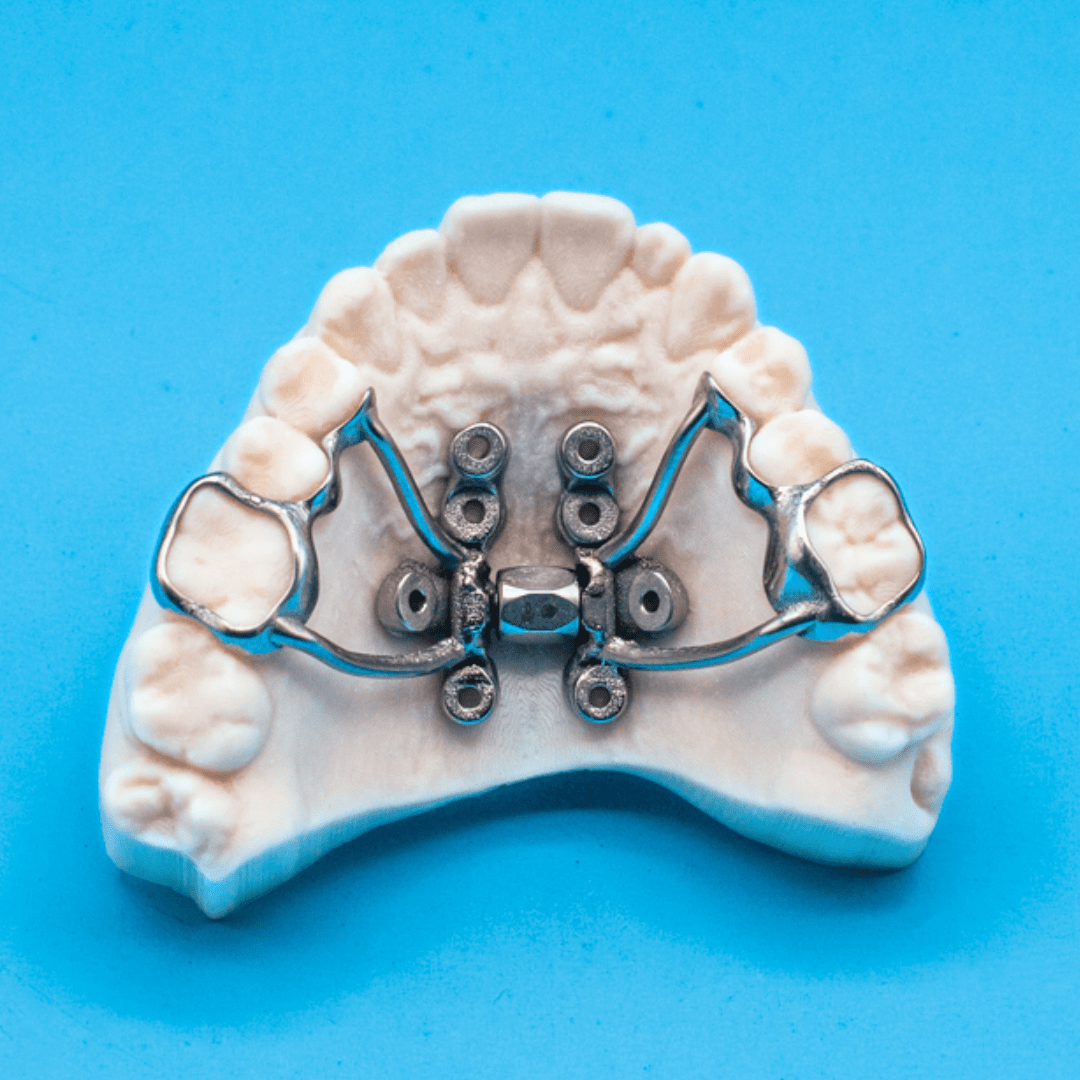
Step 4: Submit the scan for case-design review. For borderline cases (stage C suture, asymmetric anatomy, age 30+), we recommend the orthodontist submit the scan and call our tech team before submitting. The MARPE appliance we fabricate can be customized to atypical anatomy, but the staging decision still drives the candidacy.
For cases where the MARPE design wouldn’t suit the patient’s anatomy, the MSE expander may be a better option, and our digital case-design workflow supports either configuration.
When Adult MARPE Fails: Recovery Pathways
MARPE failure in an adult patient is not a clinical dead-end. The recovery pathway depends on what failed.
If the suture didn’t split (no diastema appeared, no skeletal expansion measured on follow-up CBCT) and the appliance was activated within protocol, the case is likely beyond MARPE’s range. Recovery options include SARPE referral (surgical corticotomy followed by expansion), or in selected cases, a slower MASPE (slow-protocol MARPE) attempt with revised activation.
If the TADs migrated or failed to anchor, the issue is cortical bone quality. Recovery may involve TAD re-placement in a different palatal location with adequate cortical bone (sometimes the T-zone in the anterior palate), or a hybrid appliance configuration that distributes anchorage across both TADs and molars.
If expansion occurred but was asymmetric, the case may need an appliance modification or, depending on the magnitude, segmental SARPE for the resistant side.
Most adult MARPE failures are recoverable. None should be surprises in retrospect. The CBCT review at the case-design phase usually flags the cases at risk.
The Conversation to Have with the Adult Patient
Adult patients who request non-surgical expansion deserve to hear the published success data for their age band, not the pooled headline number. They also deserve to hear what happens if MARPE doesn’t produce skeletal split.
The honest consent conversation includes three points: (1) published success rates for their age and CBCT staging, (2) the alternative if MARPE fails (typically SARPE), and (3) the timeline implications either way.
The patient who understands the actual probability of skeletal split for their case is more likely to proceed with realistic expectations and less likely to feel misled if MARPE doesn’t produce the result they hoped for.
Frequently Asked Questions
Is MARPE worth trying after 35?
For patients over 35, published MARPE success rates decline significantly compared to younger adults. CBCT-confirmed stage A-C suture and adequate cortical bone are still required for candidacy, and the patient should be informed that SARPE may become the recovery pathway if MARPE doesn’t produce skeletal split.
Does MARPE pain increase with age?
Reported discomfort during the first 48 hours of activation is broadly comparable across adult age bands, though some literature suggests older patients tolerate the activation phase less consistently due to denser bone and slower adaptation.
Can MARPE be retried if it fails?
In limited cases, yes. If the initial failure was due to TAD anchorage rather than suture maturation, repositioning the TADs in palatal regions with adequate cortical bone may allow a second attempt. If the failure was suture-driven (stage D-E confirmed retrospectively on CBCT), retrying MARPE is not recommended; SARPE is the appropriate next step.
Is there an upper age limit for MARPE?
There is no fixed upper age limit. The clinical literature consistently identifies midpalatal suture maturation as the determining variable for MARPE candidacy, not chronological age. Patients in their forties and beyond have been treated successfully with MARPE in selected cases where CBCT staging confirmed a patent or partially patent suture.
The practical reality is that the candidate pool thins significantly past age 30, and clinicians should expect to encounter more stage D-E sutures in older patients. Each case requires individual CBCT staging. A 45-year-old with a stage C suture and adequate cortical bone is a candidate. The same patient with a stage E suture is not.
Conclusion
MARPE in adults is real treatment with real outcomes, but the candidacy window is narrower than the pooled success rate suggests, and the conversation with the patient should reflect the age-stratified data, not just the headline number. Stage the suture. Check the cortical bone. Discuss the actual probability. Plan the failure pathway.
If the case is borderline, submit the scan for case-design review before prescribing.