
Last updated: May 2026
Two patients walk in the same week. Both adults. Both presenting with bilateral crossbite and stage C midpalatal sutures. Both willing to wear TAD-anchored expanders. One gets an MSE-style appliance. The other gets a custom-designed MARPE. The choice isn’t a preference. It’s an anatomy reading.
We fabricate both designs. The most common question we get from referring orthodontists isn’t “MSE or MARPE” framed as a quality ranking. It’s “what’s the right design for this scan?” That’s a better question.
How MSE Differs from a “Generic” MARPE
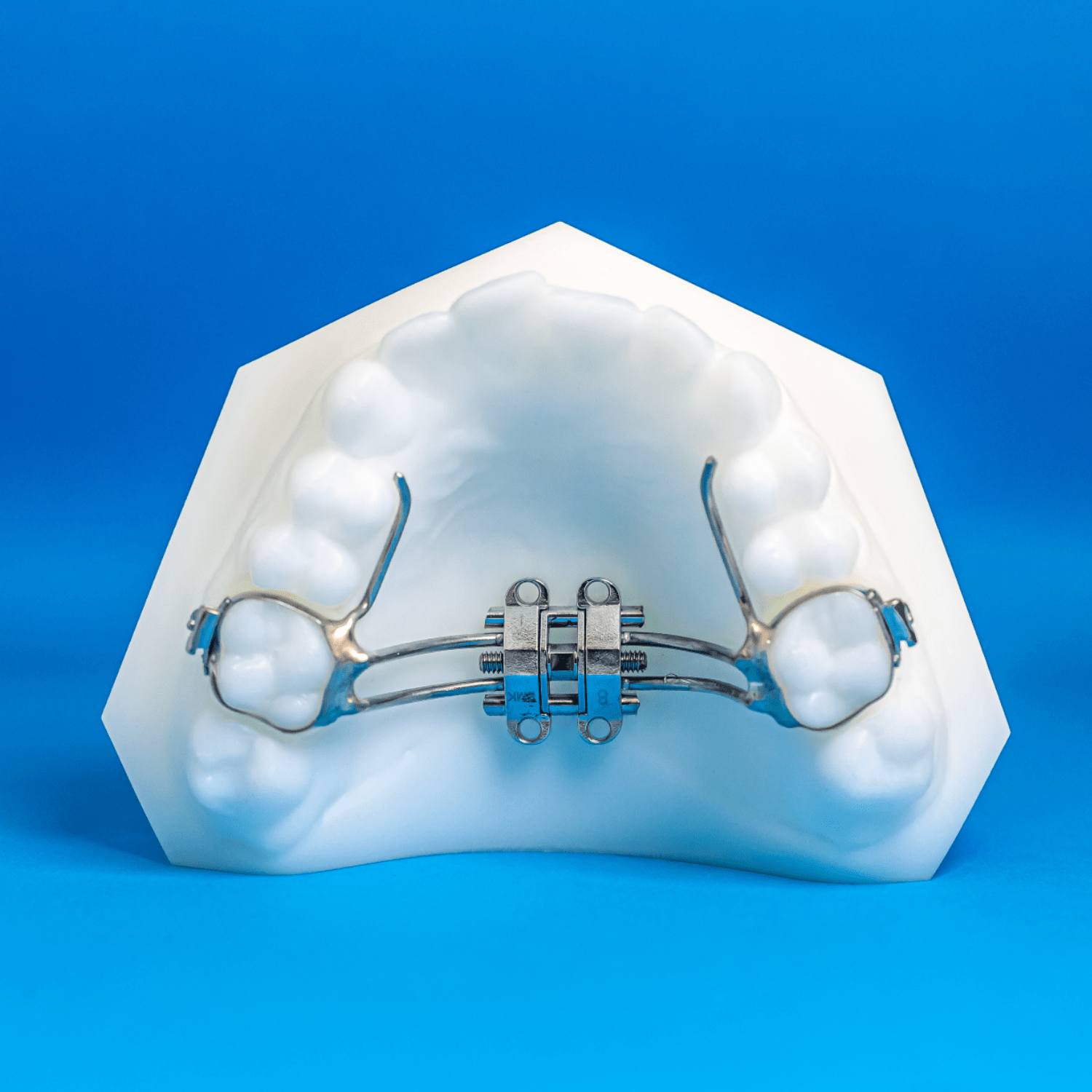
MSE (Maxillary Skeletal Expander) is a specific bone-borne MARPE design developed by Dr. Won Moon and published in 2010. It uses four miniscrews placed in the posterior palate with bicortical engagement, anchored superior to the resistance of the zygomaticomaxillary buttress and pterygomaxillary junction. MARPE is the broader category, with multiple appliance designs varying in TAD placement, hybrid vs pure bone-borne configuration, and customization to palatal anatomy.
Every MSE is a MARPE. Not every MARPE is an MSE.
Bone-Borne vs Hybrid: Why the Distinction Matters
The original distinction is between purely bone-borne expanders (where the expansion force runs only through TADs, never through teeth) and hybrid expanders (where the appliance is partly TAD-anchored and partly molar-banded). MSE is a pure bone-borne design. Many MARPE configurations are hybrid, attached to molar bands as well as palatal miniscrews.
The advantage of a pure bone-borne design is direct force transfer to the maxilla without dental compensation. The disadvantage is that it depends entirely on TAD anchorage quality. If the posterior palatal cortical bone is too thin or too soft for bicortical engagement, a pure bone-borne MSE will fail in a way a hybrid MARPE configuration may not. The hybrid design distributes load across both TAD and tooth, which trades pure skeletal effect for a wider window of anatomical candidacy.
This is why both designs exist. They are not graded on a single scale.
In our lab we fabricate our MSE expander appliance for cases where pure bone-borne anchorage is appropriate, and a custom MARPE configuration when the scan calls for it. The case design conversation usually centers on which configuration the anatomy will actually support.
Where MSE Wins
MSE is the right choice when:
- The patient has adequate posterior palatal cortical bone for bicortical engagement of all four TADs.
- The expansion target is in the posterior maxilla, where MSE’s TAD geometry generates force superior to the zygomaticomaxillary buttress and pterygopalatine sutures (the structural resistance areas adults bring to expansion).
- The suture is stage A through C (and sometimes D in select cases). Bone-borne force still produces skeletal split.
- The clinician prefers a standardized appliance design with established outcome data.
Published outcome data on MSE in adults includes reported skeletal split success rates around 86-94% in patients aged 18 to 50, when CBCT staging and posterior cortical bone thickness are confirmed appropriate at the case-design phase.
Where MSE struggles: thin posterior cortical bone, asymmetric palatal anatomy, or cases where anterior expansion is the primary goal. None of those are MSE design flaws. They are anatomy mismatches.
Where Custom-Designed MARPE Wins
Custom-designed MARPE is the right choice when:
- Palatal anatomy is asymmetric or atypical (one side has more compliant bone than the other, or the palate is unusually narrow, deep, or steep).
- Posterior cortical bone is inadequate for bicortical TAD engagement, but anterior cortical bone is sufficient. The “T-zone” of the anterior palate often has the best cortical bone for TAD anchorage in adults.
- The clinician wants TAD placement matched to the specific patient’s CBCT rather than a standardized geometry.
- The patient has had prior orthodontic appliances, surgical history, or palatal anatomy variations that make a standardized appliance a poor fit.
Recent literature supports custom-designed MARPE outcomes. A 2024 comparative study of 3D-printed custom MARPE versus conventional MSE-II found comparable skeletal expansion outcomes for both, with custom designs offering better fit and adaptability to atypical anatomy. The custom approach isn’t experimental anymore.
When we fabricate the custom MARPE we fabricate, we’re matching the appliance to a scan rather than fitting a scan to an appliance. For straightforward anatomy, that flexibility is unnecessary. For atypical anatomy, it’s what makes the case work.
An Anatomy-Driven Decision Framework
The decision tree the lab walks through with referring orthodontists:
Step 1: Confirm Angelieri staging. Stage A-C is the candidate window for either appliance. Stage D-E often requires SARPE regardless of which MARPE design is considered.
Step 2: Assess posterior palatal cortical bone thickness. If both sides have adequate bone (typically 2.5-3 mm or greater, verified on CBCT) and the patient’s palatal anatomy is bilaterally symmetric, MSE is a strong candidate.
Step 3: Check for anatomical complications. Asymmetric palatal vault, atypical cortical bone distribution, prior surgical history, or unusually narrow/deep palates push the decision toward custom MARPE design.
Step 4: Identify the primary expansion vector. If posterior expansion is the dominant goal (overcoming zygomaticomaxillary buttress resistance), MSE’s posterior TAD geometry has an advantage. If anterior expansion is the goal, anterior TAD placement in a custom MARPE design may serve better.
Step 5: Submit the scan for case-design review. For any borderline case, we recommend the orthodontist submit the scan for tech-team review before prescribing. The lab can flag anatomy concerns the consultation may not have caught, and our digital case-design workflow supports both appliance configurations.
You can also review the custom appliance specs before submission. Most cases are clear within one CBCT review. The borderline cases are the ones that benefit most from the lab conversation.
Why “MSE vs MARPE” Misses the Real Question
The framing of MSE vs MARPE treats the choice as binary. The lab perspective is that TAD purchase quality is the actual variable. If the scan shows the cortical bone the appliance needs in the location it needs it, either appliance can work. If it doesn’t, neither will, and the case needs either a different design altogether or, in some cases, a referral to SARPE.
The appliance is the easy part. The scan reading is the hard part. Order the CBCT. Check the cortical bone. Then pick the design.
Frequently Asked Questions
Is MSE the same as MARPE?
No. MSE is a specific bone-borne MARPE design with posterior bicortically-engaged miniscrews. MARPE is the broader category, including multiple designs.
Is custom-designed MARPE better than MSE?
Neither is universally better. MSE is the right design when posterior cortical bone supports bicortical TAD engagement and the case calls for posterior expansion. Custom-designed MARPE is the right design when palatal anatomy is asymmetric or atypical, when the T-zone of the anterior palate offers better cortical bone than the posterior, or when prior surgical or anatomical history makes a standardized design a poor fit.
Published outcomes for custom 3D-printed MARPE designs in recent comparative literature match conventional MSE-II appliances on skeletal expansion. The choice should be anatomy-driven, not preference-driven.
Can MSE fail in adults?
Yes. MSE failure in adults is usually attributable to suture maturation beyond the appliance’s effective range (stage D-E sutures), inadequate posterior cortical bone for bicortical TAD engagement, or asymmetric palatal anatomy that produces uneven expansion. CBCT review at the case-design stage prevents most of these.
How are MSE and MARPE different from RPE?
Conventional RPE (Rapid Palatal Expansion) is tooth-borne. Force transfers through the molars to the maxilla, producing both skeletal expansion and dental tipping in roughly equal proportions in growing patients, and primarily dental effect in adults. MSE and MARPE are TAD-anchored, with force transferred through palatal miniscrews directly to the maxillary bone. This shifts the expansion ratio toward skeletal effect and away from dental tipping, which is what makes both designs viable for adult patients whose midpalatal suture isn’t fully ossified.
Conclusion
MSE and custom-designed MARPE both work. They aren’t graded on a single scale. The right choice depends on what the CBCT shows: suture stage, posterior cortical bone thickness, palatal symmetry, and the primary expansion vector. We fabricate both. The case-design conversation we have with referring orthodontists is the one worth having before prescribing either.
If the case feels borderline, submit the scan first.